

Models
Spark serves GGUF files. The model library is the models folder, SPARK_MODELS_FOLDER (default $SPARK_STORAGE/models). This page covers how models get there, how they are identified and what you can set per model.
The library
- Any
.gguffile copied into the models folder appears in the library on the next scan. Subfolders are allowed. - Spark reads the file's header without loading it. It shows the architecture, quantization, parameter count, trained context, chat template, size and an estimate of the memory it needs.
- A split GGUF (
-00001-of-00003.ggufand so on) counts as one model. Vision projector files (mmproj) are not listed as models. GET /v1/modelslists only the models Spark can run.
Model ids and aliases
The id is the file name without .gguf and without a split suffix, in lower case, with unsafe characters replaced by dashes. SmolLM2-135M-Instruct-Q8_0.gguf becomes smollm2-135m-instruct-q8_0.
A request's model is resolved in this order, ignoring case: the id, the alias, the file name, the id of the name given, then the model's display name. When nothing matches, the request fails with 404, unless SPARK_UNKNOWN_MODEL_FALLBACK=true, which serves unknown names with the default model. A request that names no model gets SPARK_DEFAULT_MODEL, or the only model when there is one.
Set an alias on the model page to serve clients that hard-code a name, for example gpt-4o-mini. GET /v1/models lists the id and the alias.
Add models with Discover
Discover searches Hugging Face for GGUF repositories. The filters follow the Hub's own model list.
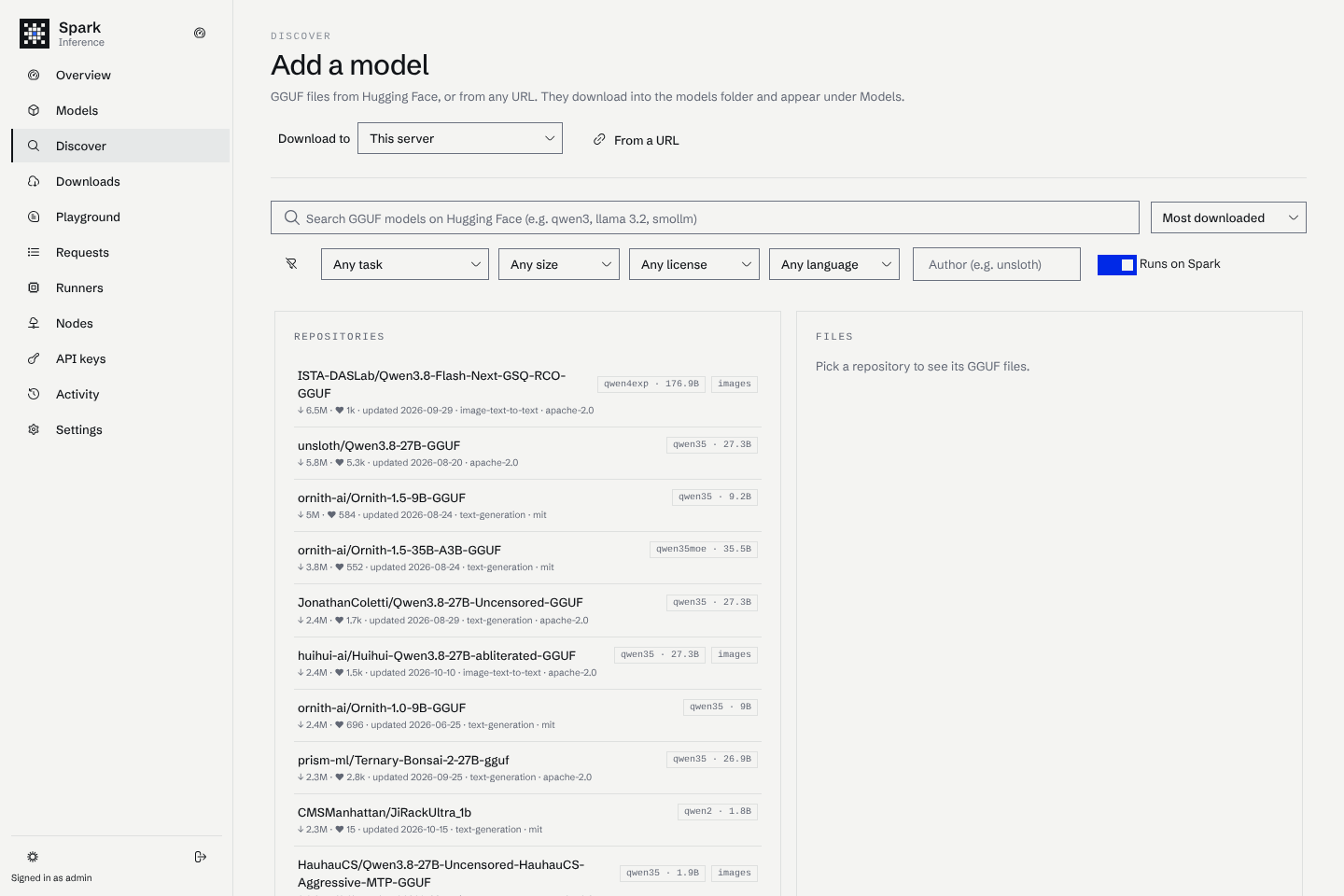
| Filter | What it does |
|---|---|
| Search and sort | Most downloaded, trending, most liked or recently updated. |
| Task, size, license, language, author | The Hub's filters. |
| Runs on Spark | Keeps only repositories whose architecture Spark runs. Discover marks a repository it cannot run, and says why. |
Open a repository to see its files by quantization and size, and pick one. A repository's vision projector is shown and downloaded with the model. A split model downloads all its parts. Download to picks this server or, on a central, a node.
From a URL downloads any URL that points at a .gguf file. A Hugging Face /blob/ link is rewritten to its download link. Set SPARK_HF_TOKEN for gated repositories and to avoid rate limits.
Downloads
- Downloads are resumable. They write
.partialfiles and use range requests, and the file's GGUF magic number is checked at the end. - Download jobs are kept in the database, so a download that the server was stopped in the middle of carries on from its partial files when it starts again.
- A dropped connection is retried 5 times with back-off, each from where the file ends.
- A failed or cancelled download has Resume on the Downloads page. Starting the same file again resumes the earlier job.
- Downloads are not checked against the Hub's checksums yet.
Per-model settings
The model page sets these. They apply the next time the model loads, and a change reloads a loaded model.
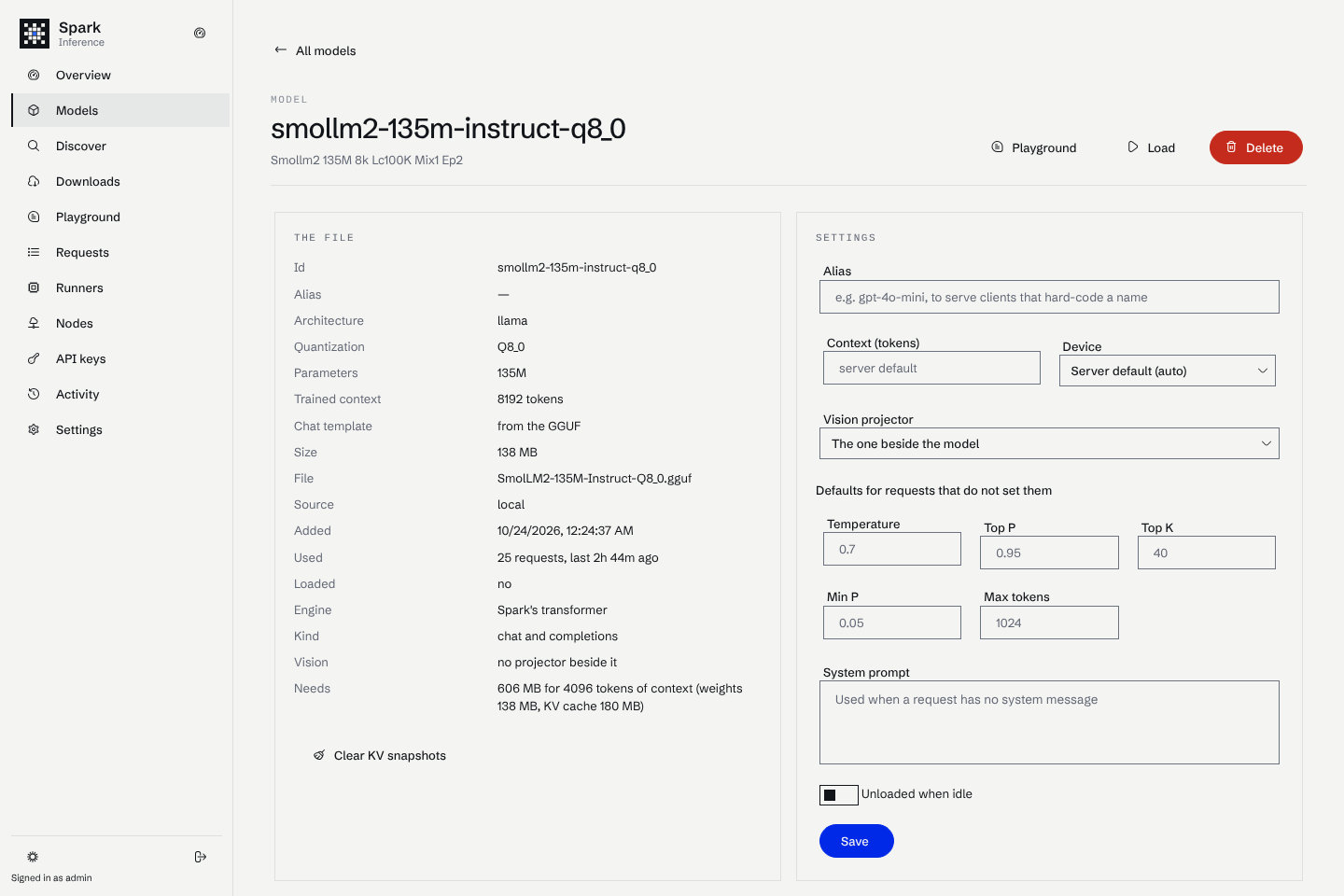
| Setting | Effect |
|---|---|
| Alias | An extra name clients can request. |
| Context (tokens) | The KV cache size. Empty uses SPARK_CONTEXT_LENGTH (4096). A prompt longer than the context is refused with 400. |
| Device | auto, cpu, cuda or cuda:N. Empty uses SPARK_DEVICE. |
| Vision projector | The mmproj file images go through. The default is the one beside the model. none makes the model text only. |
| Temperature, Top P, Top K, Min P, Max tokens | Defaults for requests that do not set them. |
| System prompt | Prepended as a system message when a request carries none. |
| Unloaded when idle | Turn off to keep the model loaded. It is then never unloaded for being idle. |
The page also has Load, Unload, Clear KV snapshots and Delete. Deleting removes the file (every part of a split model), its record and its KV snapshots, and kills its runner without saving.
Supported architectures
Spark has two engines behind one interface.
| Engine | Architectures |
|---|---|
| Spark's transformer | llama, mistral, qwen2, qwen3, granite. Quantizations Q4_0 to Q8_0, K-quants, IQ-quants, F16 and BF16. |
| TensorSharp families | Gemma 3 and 4, Qwen 3.5, 3.6, 3.8 and Next, GPT-OSS, Nemotron-H, Mistral 3, DiffusionGemma, DeepSeek 4, GLM, Hunyuan and others, with their vision projectors, thinking and tool call formats. |
| Embedding models | bert, nomic-bert, gemma-embedding2. They answer /v1/embeddings. |
An embedding model refuses chat requests, and a chat model refuses /v1/embeddings, each with a 400.
Architectures neither engine runs yet include phi3, olmo2, qwen3moe and mixtral. Image and video generation families load but have no endpoint.
Images
A model with a multimodal projector reads images. Spark pairs a model with the mmproj file beside it, or with the one named in its settings. Both APIs accept images as base64, data URIs or http(s) URLs. SPARK_IMAGE_URLS decides how URLs are fetched: public (the default) fetches only from public addresses, any from anywhere, off refuses URLs.