

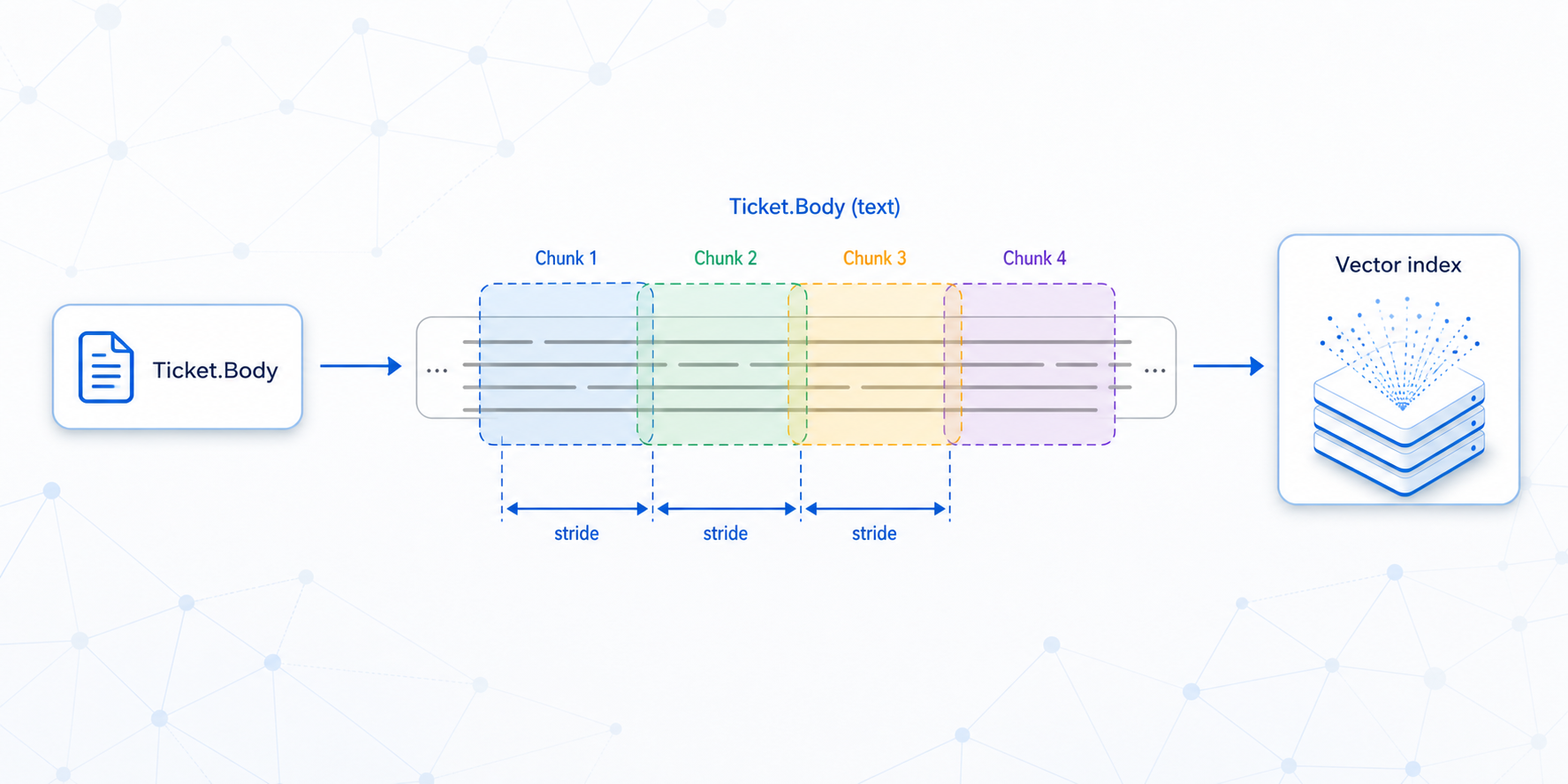
Sentence embeddings
Embeddings are the foundation. Each text field you mark as vector-indexed gets encoded into a dense vector and stored in an approximate nearest-neighbour (ANN) index. Two nodes with similar vectors are semantically similar.
Built-in models:
| Model | Max tokens | Best for |
|---|---|---|
| MiniLM | 256 | Fast, low-RAM, good for short fields |
| ArcticXS | 512 | Higher recall, default for new indexes |
| External (OpenAI-compatible) | 4096 | Highest quality, text leaves your network |
Register a vector index in code:
await Graph.Indexes.AddSentenceEmbeddingsIndexAsync(
    nodeType:  N.Ticket.Type,
    fieldName: N.Ticket.Body,
    model:     SentenceEncoderModel.ArcticXS);
Or enable it in Settings → Search → Indexes without writing code.
Find similar nodes by text:
var query = await Q().StartAtSimilarTextAsync(
    "battery drain overnight", count: 10, nodeTypes: new[] { N.Ticket.Type });

return query.EmitWithScores();
Find neighbours of a known node:
return Q().StartAt(seedUID)
          .Similar(indexUID: ticketBodyIndex, count: 10)
          .EmitWithScores();
EmitWithScores() is the only emitter that keeps the similarity score — you need it to rank and explain. The next steps build on these two lookups.