

Schema Design
Schema design is the most important step in building a Curiosity Workspace application. It determines:
- how users navigate and explore data
- how search is scoped and filtered
- how AI features can ground and enrich results
- how connectors keep data consistent over time
This page covers the design rules, then walks through three concrete enterprise schemas you can adapt: customer support, manufacturing/engineering, and a compliance knowledge base.
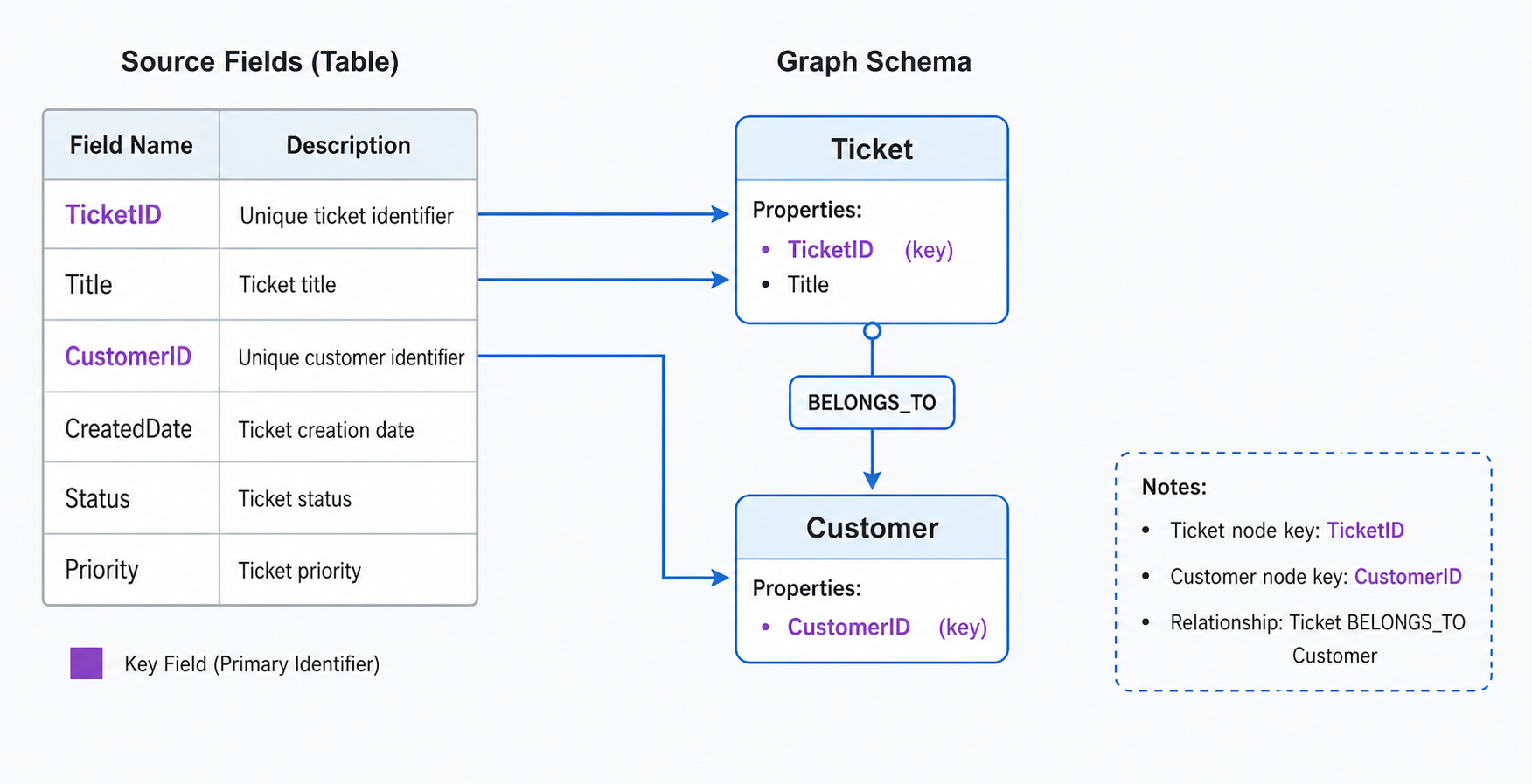
The three building blocks
A graph schema in Curiosity has three layers:
- Nodes (entities) — the "things" in your domain:
Customer,Ticket,Document,Device,Policy. Each node type is a C# class with a[Key]and zero or more[Property]fields. - Edges (relationships) — typed links between nodes:
HasTicket,Mentions,ReportsTo. Edges are first-class — you traverse, facet, and search by them. - Properties (attributes) — scalar fields for display, filtering, sorting, and search/embedding input.
Start from user journeys
Before writing your first schema, answer these five questions:
- What are the top 5 questions users ask?
- What workflows do they execute?
- Which objects do they search for first?
- What do they click on next?
- Where do they need to navigate from there?
Those answers map directly to:
- the primary node types,
- the edges between them,
- the filters and facets you must support.
If a question can't be answered with the schema you're drafting, the schema is wrong.
Keys: pick stable identity early
For each node type, define a stable key:
- Prefer source IDs. They're stable, unique, and recognized by your users.
- Synthetic keys are OK if you control allocation and store the mapping.
- Deterministic hashes (canonicalize → hash) are acceptable when source IDs don't exist, but they're brittle under schema change — any tweak to the canonicalization recreates everything.
- Avoid random IDs unless you never need to re-run ingestion against the same source.
The single biggest ingestion bug is unstable keys. If your connector produces duplicates, the key is the first thing to inspect.
Node vs property: a decision rule
Use a property when:
- the value is only displayed or filtered on the current node;
- you do not need to navigate to it as an entity;
- the value has no metadata of its own.
Use a node + edge when:
- you need cross-cutting filters (e.g., status across multiple types);
- you need navigation ("show all tickets for this customer");
- the value should have its own metadata (description, owner, lifecycle);
- the value is shared across many records (avoid duplicating spelling variants).
A quick smell test: if you find yourself writing Where(n => n.GetString("Status") == "Open") everywhere, Status probably wants to be a node — and then you can do .Out(edgeType: "HasStatus") from the open-status node and get a free facet.
Edges should read like sentences
Name edges so traversals read naturally:
Customer ─HasTicket─▶ Ticket ─ForProduct─▶ Product— reads like English.- Maintain bidirectional names when readability improves; the graph engine treats them symmetrically.
public static class Edges
{
    public const string HasTicket  = nameof(HasTicket);
    public const string TicketOf   = nameof(TicketOf);
    public const string ForProduct = nameof(ForProduct);
    public const string HasStatus  = nameof(HasStatus);
}

graph.Link(customer, ticket, Edges.HasTicket, Edges.TicketOf);
Worked example 1 — customer support
| Node | Key | Properties | Indexed for search? |
|---|---|---|---|
Customer |
Id |
Name, Tier, Region |
name only |
Product |
Sku |
Name, Category |
name |
Manufacturer |
Name |
Country |
name |
Status |
Code |
Label, IsOpen |
label |
Ticket |
Id |
Subject, Body, CreatedAt, Priority |
subject + body (text + vector) |
Message |
Id |
Author, Text, SentAt |
text (vector if long) |
Entity |
Name |
Kind |
name |
Why this shape:
- Hub entities (
Customer,Product,Ticket) are what users search for; everything else is reachable from them. - Status as a node gives a stable facet across types and metadata about each status (e.g., "open" vs "resolved").
- Messages are separate so they can be embedded individually (chunked) for better semantic retrieval.
- Entity is filled in by NLP extraction; it lets users facet by mentioned product/component names.
Worked example 2 — manufacturing / engineering docs
| Node | Key | Notes |
|---|---|---|
Document |
DocNumber |
Versioned via RevisedFrom edge to predecessor. |
Part |
PartNumber |
Canonical part. |
Assembly |
AssemblyNumber |
Sub-assemblies modeled the same way (recursive). |
Product |
Sku |
The shippable product. |
Engineer |
Email |
Mapped from SSO. |
Team |
Name |
SSO-mapped team for ACL. |
The RevisedFrom edge models history without duplicating the schema. To answer "show me revisions of doc D-12345", traverse Document {DocNumber: D-12345} → In(RevisedFrom) until no more predecessors.
Worked example 3 — compliance knowledge base
| Node | Key | Notes |
|---|---|---|
Regulation |
Code |
E.g., SOC2-CC6.1, GDPR-Art32. |
Policy |
Id |
Internal policy ID. |
Control |
Id |
The implementation of a policy. |
Audit |
Id |
A scheduled/completed audit cycle. |
Document |
Id |
Evidence: PDFs, screenshots, signed attestations. |
Team |
Name |
Who owns evidence; drives ReBAC. |
This schema is small but powerful: from a regulation node, traverse outward to find every policy → control → audit → evidence in three hops.
Indexing decisions follow the schema
Once the shape is right, the search configuration writes itself:
- Index titles, identifiers, and names as text.
- Index long descriptive fields as embeddings with chunking.
- Index status, priority, category, region as property facets.
- Add related facets for the hub entities users will filter by (
Customer,Product,Team).
See Search Optimization and Vector Search.
Schema evolution
Real schemas evolve. Plan for it:
- Add a property — safe; existing nodes get null; backfill in a scheduled task if needed.
- Add a new node or edge type — safe; register schema, ingest going forward.
- Rename a property — non-trivial; add the new property, dual-write during a deprecation window, migrate readers, remove old property.
- Change a key's type or domain — treat as a new node type; migrate, retire the old one.
- Remove a property — drop it from the schema and rebuild the search index.
See Reindexing and re-embedding for the rebuild side, and Upgrades and migrations for the operational shape.
Common anti-patterns
- Properties pretending to be nodes — repeating spelling variants in a
Tagproperty when the user navigates by tag. MakeTaga node. - Edges pretending to be properties — storing a comma-separated list of related items in a property. Make them edges.
- Over-normalizing — turning every value (every word, every author name) into a node. Keep it to things users navigate or facet.
- Missing time — no
[Timestamp]on event-like nodes means no recency sort and broken time facets. - Composite keys — keys that combine source ID + version + region. Pick one identity; model the others as edges or properties.
Where to go next
- Apply the schema to ingestion: Connectors.
- See worked schemas in real code: the HackerNews example and the Technical Support tutorial.
- Configure search on top of your schema: Search Optimization.
- Build the rest of the app end-to-end: Build your first enterprise AI app.